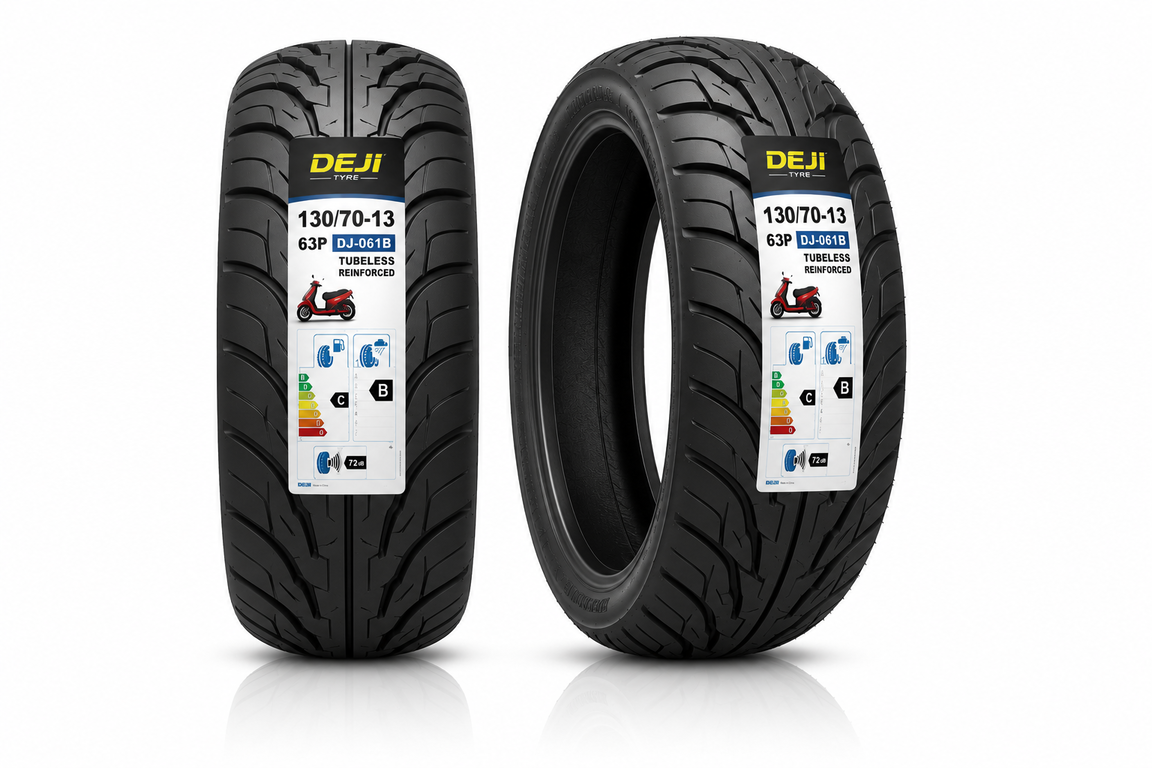

How Motorcycle Tires Are Made: Inside DEJI TIRE's Production Workshop
Motorcycle Tire Manufacturing | Production Workshop | Quality Inspection | Qingdao, China
When buyers compare motorcycle tire manufacturers in China, they often see the finished product first.
But what happens before a motorcycle tire reaches the warehouse?
Understanding the manufacturing process can help importers, wholesalers and distributors evaluate a tire manufacturer more effectively.
This article takes a closer look at the motorcycle tire production process at DEJI TIRE in Qingdao, China, from material preparation and component processing to tire building, curing, inspection and finished-product handling.
Where Are DEJI Motorcycle Tires Manufactured?
DEJI TIRE is a motorcycle tire and inner tube manufacturer based in Qingdao, China.
The factory supports the production of motorcycle tires and related products for international customers.
The manufacturing environment includes production areas, product inspection, finished-product handling and other facilities required for motorcycle tire production.
For international buyers, seeing the actual production environment can provide a clearer understanding of the manufacturer behind the products.
Step 1: Raw Material Preparation
Motorcycle tire production begins with raw material preparation.
Depending on the tire design and specification, different rubber and reinforcement materials are prepared according to the applicable production requirements.
Proper material preparation is an important starting point because the materials used in different tire components need to meet the requirements of the specific product.
The preparation stage provides the foundation for subsequent rubber processing and tire component production.
Step 2: Rubber Mixing
Rubber materials are processed and mixed according to the applicable product formulation.
The purpose of this stage is to prepare the rubber compounds required for subsequent tire components.
Different parts of a motorcycle tire may require different rubber compounds according to the product design and manufacturing requirements.
For a motorcycle tire manufacturer, rubber processing is one of the important stages within the overall production process.
Step 3: Tire Component Processing
A motorcycle tire is not made from a single piece of rubber.
Different components need to be prepared before the tire can be assembled.
Depending on the product and construction, these may include components such as:
-
Tread rubber
-
Sidewall rubber
-
Ply materials
-
Bead components
-
Other reinforcement components
The exact components and manufacturing process depend on the selected tire specification and construction.
Step 4: Tread and Sidewall Processing
Tread and sidewall components are prepared according to the selected tire specification and product design.
The tread is particularly important because it forms the part of the tire that interacts with the road surface.
During an OEM or product-development project, tread pattern selection may also be discussed based on the customer's requirements and intended application.
Step 5: Tire Building
The prepared components are brought together during the tire-building stage.
At this stage, the tire components are assembled into what is commonly referred to as a green tire.
A green tire has not yet completed the curing process.
The tire-building stage therefore plays an important role in bringing the different prepared components together according to the required structure.
Step 6: Green Tire Inspection
Before curing, the green tire can be checked according to the applicable production requirements.
The purpose is to identify issues before the tire proceeds to the next manufacturing stage.
For manufacturers, checking the product during production rather than relying only on final inspection can help maintain process control.
The exact inspection items depend on the tire specification and production requirements.
Step 7: Tire Curing
The green tire then enters the curing stage.
During curing, the tire is processed under controlled manufacturing conditions and the tread pattern is formed through the curing mold.
This is the stage where the green tire becomes a finished tire with its intended shape and tread pattern.
Curing is therefore one of the key stages in motorcycle tire manufacturing.
Step 8: Finishing
After curing, the finished tire may undergo finishing operations to address excess rubber or other production details.
The tire is then prepared for inspection.
The finishing stage helps ensure that the product is ready for final quality evaluation.
Step 9: Finished Tire Inspection
After production, finished motorcycle tires are inspected according to the applicable requirements for the selected product.
Depending on the tire specification and project, inspection may include areas such as:
-
Tire appearance
-
Dimensions
-
Tread pattern
-
Sidewall markings
-
Product condition
-
Other applicable technical requirements
The exact inspection and testing items depend on the product and applicable requirements.
For international buyers, the important point is that final products are evaluated before they move to the next stage.
Step 10: Finished Goods Warehouse
After the applicable inspection and production procedures are completed, finished tires can be transferred to the finished-goods warehouse.
The warehouse is an important part of the supply chain between production and shipment.
Finished motorcycle tires can then be organized according to product, specification, order and shipment requirements.
For buyers placing bulk orders, the warehouse and order-preparation process are also part of evaluating the supplier's overall supply capability.
Step 11: Packing and Shipment
The final stage is preparation for shipment.
Depending on the customer requirements, packing arrangements can be discussed for standard or OEM orders.
Before shipment, buyers should confirm:
-
Packing method
-
Product quantity
-
Gross and net weight
-
CBM
-
Container type
-
Loading arrangement
-
Destination port
-
Agreed trade term
The final loading quantity depends on the actual products, quantities and packing arrangement.
How Long Does Motorcycle Tire Production Take?
Production time depends on the product and the level of customization.
An existing tire pattern generally requires less development work than a project requiring a new pattern, mold or testing.
At DEJI TIRE, reference production arrangements can include different timelines for existing products, customized packaging, new mold development and more complex OEM projects.
The actual delivery schedule should therefore be confirmed according to the specific order rather than applying one standard number to every motorcycle tire.
What Is DEJI TIRE's Production Capacity?
DEJI TIRE's current stated production capacity is up to:
20,000 Motorcycle Tires per Day
The company also states a capacity of up to:
80,000 Inner Tubes per Day
Actual output depends on the product mix, production scheduling and factory operating conditions.
For importers and distributors, production capacity is one part of evaluating whether a supplier can support repeat orders and larger-volume programs.
What Products Does DEJI TIRE Manufacture?
DEJI TIRE's product range includes:
Motorcycle Tires
Motorcycle Tyres
Scooter Tires
ATV Tires
Motorcycle Inner Tubes
The available sizes, patterns and constructions depend on the company's current product range and the specific customer requirements.
Can the Manufacturing Process Support OEM Projects?
Yes, applicable OEM and ODM projects can be discussed with DEJI TIRE.
Depending on the project, customers may discuss:
-
Tire size
-
Tread pattern
-
Front or rear application
-
Sidewall branding
-
Customer logo
-
Packaging
-
Samples
-
New mold development
-
Bulk production
Not every OEM project requires a new mold.
If a suitable existing product is available, the project may be based on an existing pattern. New mold development may be required when a customer needs a new tread pattern or customized product.
Why Should Buyers Understand the Manufacturing Process?
For a motorcycle tire buyer, understanding how tires are manufactured helps put the final product into context.
A supplier evaluation can include more than price.
Buyers may also consider:
Manufacturing Environment
Can the supplier demonstrate its actual production environment?
Product Capability
Does the manufacturer produce the sizes and product categories required?
Quality Management
How are products inspected during and after production?
Production Capacity
Can the supplier support the buyer's expected order volume?
Customization
Can the factory discuss OEM branding, packaging or product development?
Communication
Can technical and commercial requirements be discussed directly with the manufacturer?
These factors can be especially important when establishing a long-term supply relationship.
Inside DEJI TIRE: From Production to Global Supply
A motorcycle tire does not simply appear in the warehouse.
The manufacturing process connects multiple stages:
Raw Materials
↓
Rubber Processing
↓
Component Preparation
↓
Tire Building
↓
Green Tire
↓
Curing
↓
Finishing
↓
Inspection
↓
Finished Goods
↓
Packing & Shipment
This production chain provides a practical way for international buyers to understand how DEJI TIRE's factory environment supports motorcycle tire manufacturing.
Frequently Asked Questions About Motorcycle Tire Manufacturing
How are motorcycle tires manufactured?
Motorcycle tire manufacturing generally involves material preparation, rubber processing, component preparation, tire building, curing, finishing and inspection. The exact process varies according to the tire specification and construction.
Where does DEJI TIRE manufacture motorcycle tires?
DEJI TIRE manufactures motorcycle tires in Qingdao, China.
Is DEJI TIRE a motorcycle tire manufacturer?
Yes. DEJI TIRE is a motorcycle tire and inner tube manufacturer in China.
What products does DEJI TIRE supply?
DEJI TIRE supplies motorcycle tires, motorcycle tyres, scooter tires, ATV tires and motorcycle inner tubes.
Can DEJI TIRE provide OEM motorcycle tires?
Yes. Applicable OEM and ODM projects can include product specifications, tread patterns, sidewall branding, packaging and other agreed requirements.
Can buyers visit the DEJI TIRE factory?
International customers can arrange factory visits to learn more about the manufacturing environment, products and production capabilities.
What is DEJI TIRE's motorcycle tire production capacity?
DEJI TIRE's current stated capacity is up to 20,000 motorcycle tires per day, while inner tube capacity is up to 80,000 pieces per day. Actual output depends on product mix and production scheduling.
Looking for a Motorcycle Tire Manufacturer in China?
If you are sourcing motorcycle tires or tyres from China, understanding the manufacturer behind the product is an important part of supplier evaluation.
DEJI TIRE welcomes importers, wholesalers, distributors and motorcycle brands to learn more about our products, manufacturing environment and OEM/ODM capabilities.
Send us your:
Tire Sizes + Required Quantities + Target Market + OEM Requirements
Our team can check suitable products and discuss samples, customization, production and shipment.
DEJI TIRE
Motorcycle Tire & Inner Tube Manufacturer in China
OEM & ODM | Factory Supply | Global Export
Address: 118# Douloushan Road, Lingang Development Area, Huangdao District, Qingdao, China
Tel: +86-532-85185798
WhatsApp: +86-15865500188
Email: wheelcart@wheelcart.cn
Website: www.wheelcart.cn
How DEJI TIRE Controls Motorcycle Tire Quality from Production to Finished Product
Motorcycle Tire Sourcing Guide: How to Buy from China